Summer Health: Pediatric care that answers in about 15 minutes, not two weeks

Summer Health: Pediatric care that answers in about 15 minutes, not two weeks

Text-based access to board-certified pediatricians, plus sleep, nutrition, and lactation experts, positions Summer Health as the fast lane parents actually need at 2am.

Summer Health connects parents to board-certified pediatricians and adjacent specialists within about 15 minutes at any hour, by text. Anyone who has parented a young child through a midnight fever knows the actual bottleneck isn't access to medical knowledge in the abstract, it's a specific, credentialed answer fast enough to resolve the worry or justify an ER trip.

Most pediatric telehealth platforms still route that need through a scheduling flow built for routine, daytime care, which is the wrong shape for the moments parents actually reach for their phone.

Text-first, not video-first

Rather than defaulting to a scheduled video visit, the model is built around asynchronous text, which better matches how a tired parent actually wants to ask "is this fever normal" at midnight. A parent holding a crying child doesn't want to find a quiet spot for a video call, they want to type with one hand and get a real answer back quickly. Bundling in sleep, nutrition, and lactation experts within the same text thread means a new parent isn't bouncing between four different apps depending on which 2am problem they're facing.

A response window of about 15 minutes, at any hour, is a materially different promise than the days-long wait for a standard pediatric appointment.

Speed is the actual product

In pediatrics, most parent anxiety resolves the moment a credentialed clinician responds, not once a full visit happens. Summer Health's bet is that speed of first response matters more than the depth of a single encounter, a different design choice than most virtual pediatric platforms make, most of which optimize for thoroughness and reimbursable visit length. That bet also reframes what the platform competes against: not other pediatric telehealth apps on clinical depth, but the emergency room and urgent care as the thing a worried parent reaches for at an inconvenient hour.

Whether the model holds at scale

Watch whether response times hold as Summer Health's user base grows, since a 15-minute promise is easy at a small scale and much harder to sustain nationally without a much larger clinician bench. Speed-based promises are fragile precisely because they're the first thing to slip when demand outpaces staffing, and unlike a scheduled-visit model where a backlog is at least manageable, a text-based, always-on promise either holds or visibly breaks for the parent waiting on an answer.

Also worth watching: whether Summer Health expands its adjacent-specialist roster beyond sleep, nutrition, and lactation, since each addition strengthens its claim on being the one relationship a family relies on through early childhood.

Joon: A game kids actually want to play turns daily tasks into treatment

Joon: A game kids actually want to play turns daily tasks into treatment

Built by a founder who has ADHD and grew up gaming, Joon has passed a million users by making a digital therapeutic feel like a video game rather than a chore chart.

Joon is a game-based digital therapeutic for children aged 6 to 12 with ADHD, autism, anxiety, and depression. Most tools built for this age group and diagnosis mix are designed by clinicians first and made kid-friendly second, which is part of why so many struggle with sustained engagement past the first few weeks. Joon inverts that order, and the retention numbers suggest that ordering matters more than it's usually given credit for.

Virtual pets that level up on real-world proof

Kids care for virtual pets that only level up once they complete real-world "quests," from brushing teeth to homework, all set and tracked by parents and clinicians through the app. The mechanic works because the reward loop lives entirely inside the game world, while the actual behavior change happens in the physical world. Parents and clinicians set the specific quests and thresholds on the backend, so the app can be tailored to a child's treatment goals without the child ever feeling clinically managed.

Joon has passed a million users and tens of thousands of paying families, a scale most pediatric digital therapeutics never reach.

Adherence solved through motivation, not reminders

Most pediatric behavior tools rely on reminders and nagging, which is exactly what a child with ADHD tunes out fastest, and often what strains the parent-child relationship over time, casting the parent as enforcer rather than collaborator. Joon flips the mechanic: motivation comes from the game itself, which is likely why it's reached paying-family scale that adherence-dependent categories usually struggle with. It also gives clinicians a more objective way to track whether an intervention is working, since quest-completion data replaces asking a parent "did you manage to get them to do it."

Whether clinical partnerships follow consumer scale

Watch whether Joon's million-user consumer base translates into formal clinical or school partnerships, since that's usually the next step once a pediatric digital therapeutic proves consumer demand at this scale. A company with proven engagement and paying-family conversion in a notoriously hard-to-retain category is well positioned to pitch schools, pediatric practices, and even payers on its engagement data as a proxy for adherence. Whether Joon pursues that path itself, or becomes an acquisition target for a larger pediatric behavioral health platform, is the more interesting question over the next year or two.

Tiny Health: Turning an overlooked biomarker into an early warning system for lifelong health

Tiny Health: Turning an overlooked biomarker into an early warning system for lifelong health

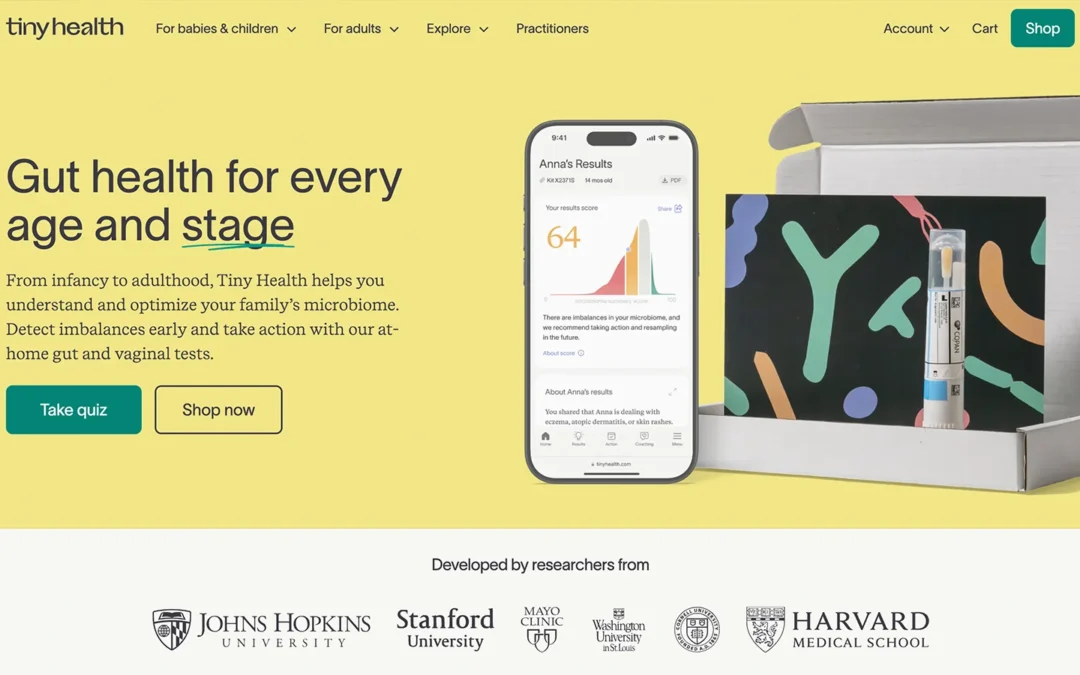
More than 40% of US children live with at least one chronic condition, and Tiny Health is targeting the microbiome's most shapeable window, the first 1,000 days of life, when the gut is still forming and roughly 80% of the immune system takes shape.

Tiny Health was founded in 2020 by serial entrepreneur Cheryl Sew Hoy, with co-founder Donald Koo, after her own child's eczema and allergies were traced back to gut imbalances, and she found no infant gut test existed to catch it earlier. That personal origin story is now a company with genuine scientific depth behind it.

Strain-level data, not a genus-level snapshot

Tiny Health runs shotgun metagenomic sequencing, which reads microbial strains and their functions directly, a materially deeper view than the genus-level snapshot most consumer gut tests offer. The tests span pregnancy, postpartum, infancy, childhood, adult gut, and vaginal health, developed with researchers from Johns Hopkins. The company has tested over 100,000 people in three years and has expanded into the EU, Canada, and Mexico.

76% of infants tested increased beneficial bacteria, and 60% improved symptoms after following Tiny Health's recommendations, real outcomes data behind a consumer-facing test category that rarely publishes any.

A moat that can't be faked in a pitch

Tiny Health is attacking a real crisis at the single moment it's most reversible. The moat here is scientific and genuinely hard to copy: proprietary strain-level data, real clinical rigor, and a research posture that most consumer testing brands never attempt, since it's slower and more expensive than shipping a genus-level test and calling it done. That's precisely the kind of domain depth that takes years to build and can't be replicated by a fast-moving competitor in a single funding cycle.

Turning a biomarker into a category

Tiny Health is effectively trying to turn an overlooked biomarker, the infant and family microbiome, into an early warning system for lifelong health, not just a one-time consumer test. Watch whether the company's international expansion into the EU, Canada, and Mexico brings the same research rigor with it, or whether regulatory and reimbursement differences across those markets force a leaner, less research-heavy version of the product abroad.

Behavioral health claims are 36 times any other telehealth category, and that concentration made and unmade startups this year

Behavioral health claims are 36 times any other telehealth category, and that concentration made and unmade startups this year

Telehealth didn't become healthcare for everything, and the startups that bet otherwise are the ones getting acquired out rather than the ones setting the pace.

Telehealth usage has settled into a clear, narrow pattern this year, and the startups that built around that narrowness are outperforming the ones that built for breadth.

A 36x concentration gap

Behavioral health drives 68.9% of US telehealth claims, roughly 36 times the next closest category, according to FAIR Health data, while physician weekly telehealth use has climbed to 71.4%, nearly triple 2018 levels, per the American Medical Association.

Talkspace, built specifically around behavioral health's virtual-first shift, was acquired by Universal Health Services for approximately $835M in March 2026, discussed earlier in this issue's funding and exits section, a direct commercial validation of that narrow-focus strategy. That exit sits alongside Talkiatry's funding dominance in the previous article, two separate data points, one in M&A and one in venture funding, both pointing at the same specialty.

A category driving 36 times the claims volume of its nearest rival isn't evidence of broad telehealth adoption, it's evidence of sharp concentration in one specialty.

Breadth is the losing bet, not the safe one

Founders still pitching broad "telehealth for everything" platforms are out of step with where the claims data, and the exits, actually are.

The startups that picked a single condition or narrow cluster of conditions and built deep virtual-care models around it, behavioral health chief among them, are the ones showing up in both the claims data and the acquisition activity. Breadth, once considered the safer, more defensible strategy, has turned out to be the riskier one, a pattern consistent with Hinge Health's MSK-specific hybrid model and Talkiatry's psychiatry-specific funding dominance elsewhere in this section.

Who tries to replicate the concentration next

Watch whether a virtual specialty startup outside behavioral health, MSK or psychiatry can replicate this level of concentration in its own category next, or whether those categories stay more evenly split with in-person care.

The startups that figure this out early, choosing depth in one condition over breadth across many, are likely to be the acquisition targets and funding stories that fill this section of next year's issue.

Preventive health screening raised big checks in 2026, but the money went to six companies

Preventive health screening raised big checks in 2026, but the money went to six companies

Headline funding numbers hide just how concentrated this category really is, and that matters for anyone benchmarking against it.

Preventive health screening looks like a booming category from the top-line funding figures. Look at the distribution of that money and a much narrower story appears.

A 24-month concentration snapshot

Over the past 24 months, the largest single deal in preventive health screening represents 25.89% of all disclosed capital, the top 3 deals reach 58.9%, and the top 5 deals reach 72.37%, according to New Market Pitch.

Function Health's $298M round is the largest deal in the dataset, followed by Neko Health's $260M Series B and Prenuvo's $120M Series B. Of 23 disclosed deals across the period, only 6 were $50M or larger, funding companies including Function Health, Neko Health, Prenuvo, Harbinger Health, Sprinter Health and ClearNote Health; the rest were split across smaller seed and Series A checks, 4 deals below $5M, 9 between $5M and $20M, and 4 between $20M and $50M, funding early evidence-building and initial distribution rather than scale.

Adjacent proteomics-focused biomarker companies, including SomaLogic, Quantum-Si, Nautilus Biotechnology, Alamar, Seer, Olink, IsoPlexis and Scipher Medicine, have together raised more than $3.9B, showing that the concentration pattern in preventive screening specifically doesn't necessarily hold across every adjacent biomarker category.

The wrong comparison set is common

6 of 23 deals account for the overwhelming majority of the category's dollars, the same barbell pattern showing up in digital health funding overall this year.

An early-stage founder in this category should not benchmark their own raise against Function or Neko's numbers. The realistic comparison set is the much larger group of smaller checks funding evidence and early distribution.

Pitching against the wrong comparables is a common, avoidable mistake that shows up in founder expectations more than in the deals actually available to them, and it can lead to under-preparing for what a realistic first or second round actually looks like in this category.

The graduation to track

Watch which of this year's smaller, evidence-stage rounds graduates into a scaled Series B next, since that transition, from proving clinical value to proving commercial scale, is where the category's real founder risk actually sits, far more than in the initial seed or Series A decision itself.

Also watch whether strategic healthcare investors already active across the biomarker space, Roche, Illumina, GE Healthcare, Sonic Healthcare, Lilly, Labcorp and Pfizer among them, extend that activity specifically into preventive screening, since their entry would change who the realistic acquirers are for this category's smaller players.