Function Health: Reframing lab testing as a consumer-owned baseline, not a reactive diagnosis

Function Health: Reframing lab testing as a consumer-owned baseline, not a reactive diagnosis

A membership giving consumers over 100 lab biomarkers a year, with a clear action plan attached, turns an annual physical's worth of labs into something a patient owns and understands themselves.

Function Health offers a membership giving consumers over 100 lab biomarkers a year with a clear action plan. Most people's relationship with lab testing is entirely reactive, a doctor orders a handful of tests only after a symptom or concern arises, and the results get filed away in a portal the patient rarely revisits or fully understands. Function's bet is that flipping that relationship, giving people a large, recurring biomarker panel proactively rather than reactively, changes how people relate to their own health data.

Ownership and interpretation, not just the raw numbers

The differentiator isn't running more tests, it's pairing a large biomarker panel with a clear, consumer-facing action plan, since raw lab results without interpretation have limited value to most people. A hundred-plus biomarker panel handed to a patient with no context would just be an intimidating spreadsheet, the interpretation layer, flagging what's out of range and explaining what to actually do about it, is what turns that raw data into something usable, and it's the part most consumer lab-testing products historically skip.

A standard annual physical typically covers a small fraction of the biomarker panel Function Health runs, reframing what "preventive testing" means for a consumer used to a much thinner default.

Prevention as a baseline, not an event

Reframing lab testing from a reactive, symptom-triggered diagnosis into a proactive, consumer-owned baseline is a genuine shift in how people relate to their own health data, not just a bigger test panel wrapped in better marketing. Once a person has a full year-over-year biomarker history of their own, health tracking stops being something that only happens when something's already wrong, and starts becoming a continuous baseline they can watch trend over time, which is a meaningfully different relationship to one's own health data than most people have ever had access to.

Whether the action-plan layer scales with membership growth

Watch whether the clinical interpretation and action-plan layer keeps pace with membership growth, since a large biomarker panel without genuinely personalized guidance risks becoming data without insight at scale. Interpretation is a much harder thing to scale than lab logistics, since it requires either a large clinical team or a very well-built decision-support system behind the scenes, and it's the piece most likely to get diluted first if membership growth outpaces the company's ability to staff or build for it.

Grow Therapy: Attacking therapy’s biggest barrier, cost and access, at national scale

Grow Therapy: Attacking therapy’s biggest barrier, cost and access, at national scale

A marketplace helping therapists accept insurance and patients find in-network care goes after the two things that keep the most people out of therapy altogether.

Grow Therapy is a marketplace helping therapists accept insurance and patients find in-network care. Most therapy-access startups focus almost entirely on the patient side of the problem, better search, faster booking, more provider listings, while leaving the supply-side reason so many therapists don't accept insurance in the first place largely untouched. Grow Therapy's model is built around fixing both sides at once.

Fixing the therapist's side of the equation, not just the patient's

Most therapy-access startups focus entirely on patient-facing search. Grow Therapy also solves the harder, less visible problem: helping independent therapists actually navigate insurance credentialing and billing, which is often why they avoid accepting insurance in the first place. Credentialing and claims administration are notoriously time-consuming for a solo practitioner, and many therapists simply opt out of insurance entirely rather than absorb that administrative burden, which is precisely the burden Grow Therapy takes on for them.

Cost and access, not clinical quality, are consistently cited as the two single biggest barriers to therapy utilization, which is exactly the pair Grow Therapy is built to remove.

A two-sided marketplace fix for a two-sided problem

By making it administratively easier for therapists to accept insurance, Grow Therapy grows the supply of in-network care, not just the visibility of it. That's a structurally different, and arguably more durable, approach than a search-and-discovery platform alone, since a directory of therapists who don't accept insurance doesn't actually solve the access problem for most patients, it just makes the existing shortage easier to browse.

Supply growth as the real metric to track

Watch growth in the number of therapists newly accepting insurance through the platform, rather than just patient sign-ups, since supply-side growth is the harder and more defensible number in a two-sided marketplace like this one. Patient demand for affordable therapy is effectively unlimited relative to current supply, so the constraint that actually determines Grow Therapy's ceiling is how many therapists it can bring into the insurance system, not how many patients it can attract to browse a still-limited pool.

Hone Health: A proactive model for a group that usually avoids care

Hone Health: A proactive model for a group that usually avoids care

Pairing at-home hormone testing with physician-guided treatment gives Hone Health a wedge into men's health, a category defined less by lack of options and more by lack of engagement.

Hone Health is a men's health and longevity platform that pairs at-home hormone testing with physician-guided treatment. Men's health as a category has never really suffered from a lack of available treatments, testosterone therapy and related interventions have existed for decades, it's suffered from men simply not showing up to get evaluated in the first place. Hone's model is built around solving that engagement problem before trying to solve anything clinical.

Testing first, engagement second

Starting with an at-home hormone test rather than a consultation lowers the barrier to entry for a population that statistically avoids scheduling preventive care, turning "get tested" into a much smaller ask than "book a doctor's appointment." The at-home kit removes the two biggest friction points at once: the discomfort of an in-person conversation about symptoms many men are reluctant to raise, and the logistical hurdle of scheduling a visit they weren't already inclined to make. By the time a physician conversation happens, the patient already has data in hand, which shortens and de-stigmatizes the actual clinical encounter.

Men are well documented to engage with preventive healthcare at lower rates than women across nearly every age bracket, making the at-home-first entry point a deliberate design choice rather than a convenience feature.

Removing the appointment as the first step

The single biggest lever in men's health engagement isn't better treatment, it's getting men to start at all. By making the test itself the entry point rather than a scheduled visit, Hone Health is solving an engagement problem before it becomes a clinical one. That sequencing, test first, then talk, also changes the tone of the eventual physician conversation, since it starts from concrete data rather than a man having to volunteer symptoms he might otherwise minimize or avoid mentioning.

Whether testing converts into ongoing care

Watch the conversion rate from initial at-home test to ongoing physician-guided treatment, since that's the real measure of whether the low-friction entry point is actually building lasting engagement or just generating one-off test purchases. A test kit that gets purchased once and never followed up on isn't solving the underlying engagement problem, it's just relocating it slightly. Hone's long-term defensibility depends on proving that the testing wedge reliably converts into a continuing physician relationship, not just a single transaction.

Midi Health: A national clinical model for a life stage medicine has ignored for decades

Midi Health: A national clinical model for a life stage medicine has ignored for decades

Virtual, insurance-covered perimenopause and menopause care in all 50 states shows how fast a category can professionalize once someone builds the clinical and payer infrastructure it was missing.

Midi Health delivers virtual, insurance-covered care for perimenopause and menopause across all 50 states. Menopause is a universal life stage that medicine has treated, for decades, as an afterthought, undertaught in medical school and under-covered by insurance, largely left to patients to self-manage or seek out the small handful of specialists trained to treat it properly. Midi's rise is as much a story about building missing infrastructure as it is about clinical care itself.

National coverage from day one, not a regional pilot

Rather than launching city-by-city, Midi built toward all-50-state, insurance-covered coverage as the model itself, treating national scale as the starting point rather than a distant goal. That's a meaningfully different approach than most virtual care startups take, most of which prove a model in one or two states before slowly expanding, since building the clinical staffing and payer relationships needed for true national coverage from the outset is expensive and operationally complex. Midi's bet was that demand for competent menopause care was broadly and evenly distributed enough that a slow rollout would leave too much unmet demand on the table.

Menopause care has historically been under-taught in medical school and under-covered by insurance simultaneously, a structural gap Midi's model addresses on both sides at once.

Building the infrastructure medicine skipped

Medicine has largely ignored menopause as a distinct, clinically serious life stage for decades, leaving both training and reimbursement thin. Midi's contribution isn't a new treatment, it's the missing clinical and payer infrastructure that lets existing, well-established treatments actually reach patients at scale. That infrastructure-first framing also explains why the category has professionalized so quickly once someone built it, competitors now have a working national template to measure themselves against rather than starting from nothing.

Category maturity raising the bar for everyone else

Watch how quickly the broader menopause category, including newer entrants, converges toward the national, insurance-backed standard Midi has set, since that standard is quickly becoming the baseline rather than a differentiator. A new entrant today has to match national coverage and payer contracts just to be considered credible, a much higher starting bar than existed even two or three years ago. Whether smaller, regionally-focused competitors can survive against that baseline, or get absorbed by it, is worth tracking over the next few funding cycles.

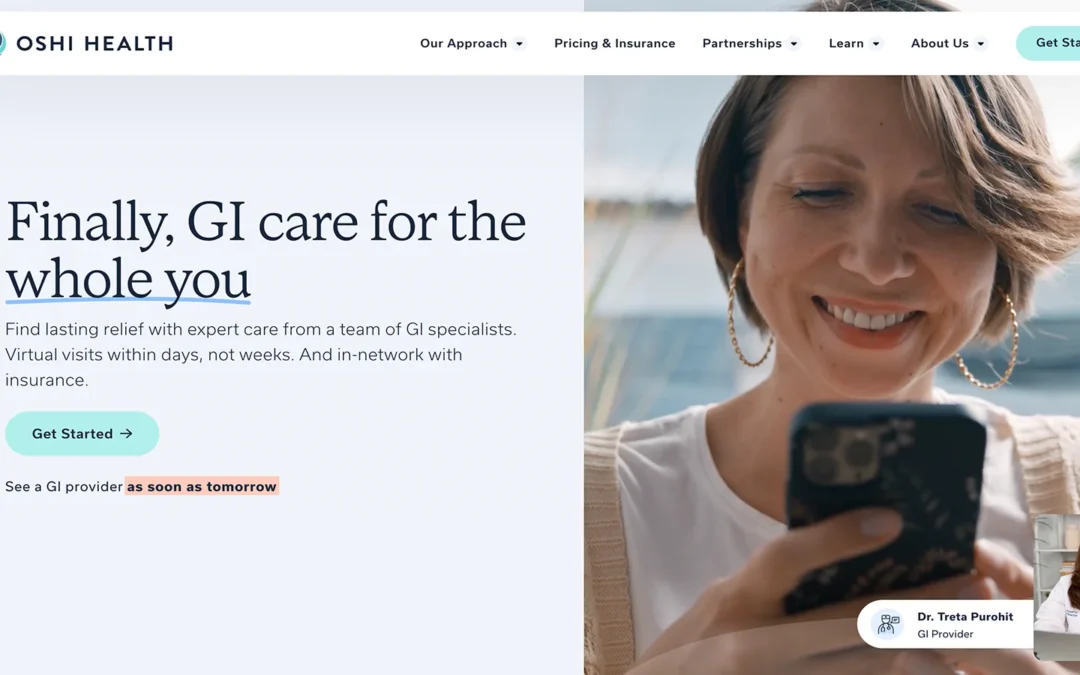
Oshi Health: Proving a “hard” specialty can go fully virtual

Oshi Health: Proving a “hard” specialty can go fully virtual

GI care was long considered un-virtualizable, and Oshi Health's multidisciplinary, in-network model is the clearest counter-example currently operating at national scale.

Oshi Health is a virtual GI clinic delivering multidisciplinary digestive care in-network, nationwide. Gastroenterology has historically sat near the bottom of the list of specialties anyone expected to go virtual, since so much of the category's traditional workflow assumes procedures and in-person exams. Oshi's entire premise is a direct challenge to that assumption, and the fact that it's operating at national, in-network scale rather than a narrow regional pilot is the more interesting data point.

Multidisciplinary, not just a single specialist

Rather than offering only a GI physician or only a dietitian, Oshi combines both alongside behavioral health support in one coordinated virtual care team, which mirrors how digestive conditions are actually treated in the best in-person settings. Chronic GI conditions are notoriously multifactorial, diet, stress, gut-brain interaction, and medication management all interact, which is why fragmented, single-specialist care so often underperforms even when each provider is individually excellent.

By building coordination into the platform itself, Oshi replicates the structural advantage of an integrated academic GI center without requiring the patient to live near one.

GI has historically been treated as a "hands-on" specialty requiring procedures and in-person exams, making Oshi's fully virtual, in-network model a genuine proof point rather than a marginal convenience play.

Lower total cost, not just lower friction

The claim that matters most here isn't convenience, it's total cost of care. Delivering coordinated GI care remotely, at lower total cost than the fragmented specialist path most patients currently take, is the kind of ROI story payers actually respond to. Uncoordinated GI care tends to generate a predictable, expensive pattern: repeated ER visits for flare-ups, redundant testing, and delayed diagnosis. A platform that can demonstrably interrupt that pattern has a genuinely differentiated pitch to the payers who decide whether a specialty like this scales nationally.

Whether other "un-virtualizable" specialties follow

Watch whether Oshi's model gets replicated in other specialties long assumed to require in-person care, since a successful GI precedent lowers the perceived risk for payers evaluating the next specialty to virtualize. Every specialty that proves a fully virtual, multidisciplinary model at scale makes it structurally easier for the next one to raise capital and sign payer contracts. Rheumatology and endocrinology, with similarly multifactorial, chronic-management profiles, are the most plausible next candidates, and Oshi's continued in-network expansion will be one of the clearest signals of whether payers are actually convinced by the total-cost argument.