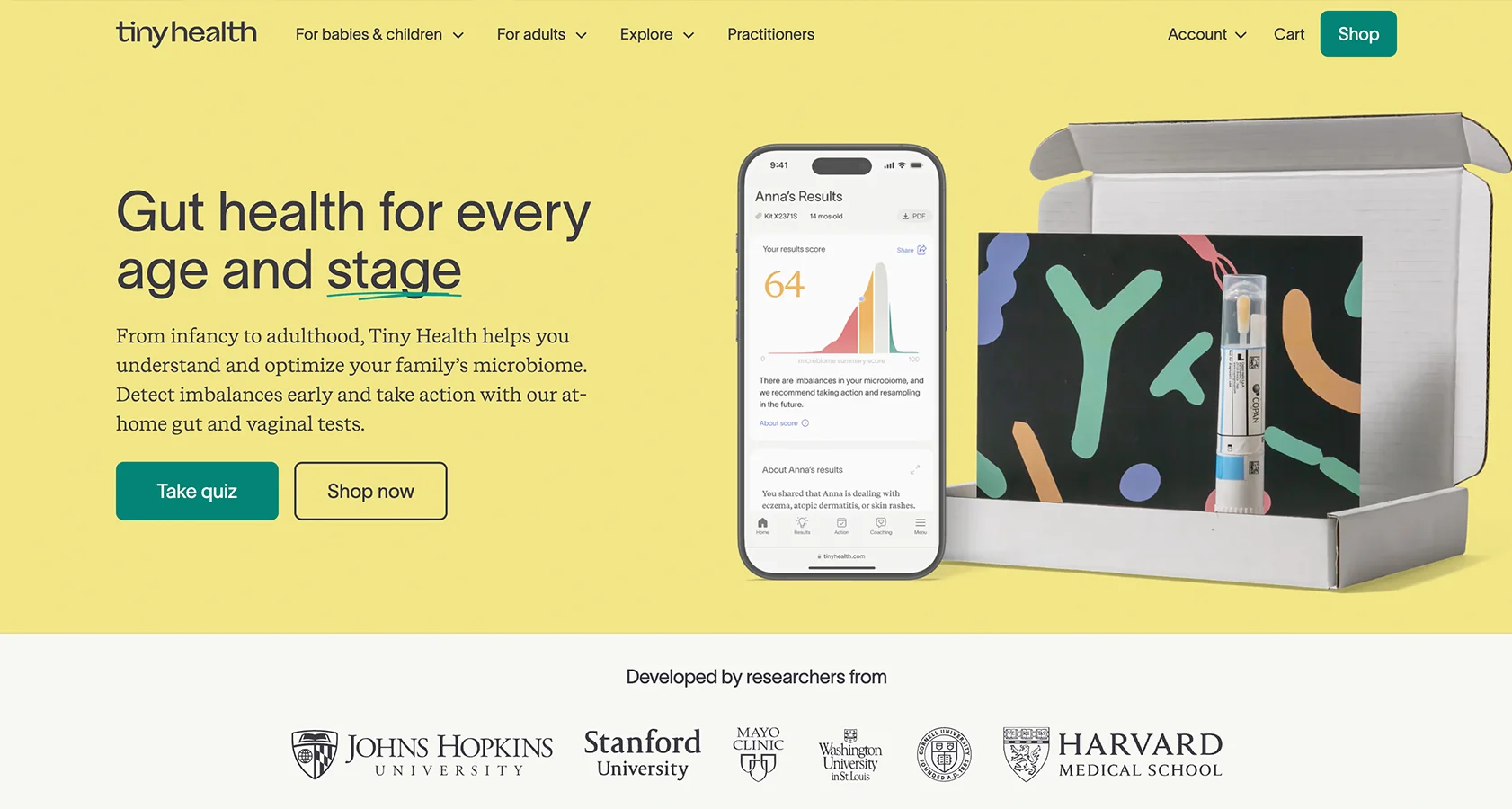
More than 40% of US children live with at least one chronic condition, and Tiny Health is targeting the microbiome's most shapeable window, the first 1,000 days of life, when the gut is still forming and roughly 80% of the immune system takes shape.
Tiny Health was founded in 2020 by serial entrepreneur Cheryl Sew Hoy, with co-founder Donald Koo, after her own child's eczema and allergies were traced back to gut imbalances, and she found no infant gut test existed to catch it earlier. That personal origin story is now a company with genuine scientific depth behind it.
Strain-level data, not a genus-level snapshot
Tiny Health runs shotgun metagenomic sequencing, which reads microbial strains and their functions directly, a materially deeper view than the genus-level snapshot most consumer gut tests offer. The tests span pregnancy, postpartum, infancy, childhood, adult gut, and vaginal health, developed with researchers from Johns Hopkins. The company has tested over 100,000 people in three years and has expanded into the EU, Canada, and Mexico.
76% of infants tested increased beneficial bacteria, and 60% improved symptoms after following Tiny Health's recommendations, real outcomes data behind a consumer-facing test category that rarely publishes any.
A moat that can't be faked in a pitch
Tiny Health is attacking a real crisis at the single moment it's most reversible. The moat here is scientific and genuinely hard to copy: proprietary strain-level data, real clinical rigor, and a research posture that most consumer testing brands never attempt, since it's slower and more expensive than shipping a genus-level test and calling it done. That's precisely the kind of domain depth that takes years to build and can't be replicated by a fast-moving competitor in a single funding cycle.
Turning a biomarker into a category
Tiny Health is effectively trying to turn an overlooked biomarker, the infant and family microbiome, into an early warning system for lifelong health, not just a one-time consumer test. Watch whether the company's international expansion into the EU, Canada, and Mexico brings the same research rigor with it, or whether regulatory and reimbursement differences across those markets force a leaner, less research-heavy version of the product abroad.