Menopause startups have moved from wellness app to insurance-backed medicine in a few short years

Menopause startups have moved from wellness app to insurance-backed medicine in a few short years

FDA clearance and national insurance contracts are now the baseline for a menopause startup, not the differentiator they were a few years ago.

Menopause and midlife care is one of the clearest examples of a women's health category maturing from awareness campaign into funded clinical infrastructure, and the pace of that maturity has caught even some operators inside the category off guard.

A cohort that no longer looks like an app store

A cohort of insurance-backed virtual menopause platforms, including Midi Health, Elektra Health, Alloy Women's Health, Evernow and Vira Health, now compete for a national patient base rather than a wellness-app niche.

Osteoboost Health raised an $8M seed round in April 2026 for an FDA-cleared wearable treating low bone density in postmenopausal women through targeted vibration therapy, backed by Ambit Health Ventures, Emmeline Ventures, Disrupt Health Impact Fund, Esplanade Ventures and Portfolia, a device-based approach sitting alongside the virtual care platforms rather than competing directly with them.

That same week, a separate maternal health round closed for Wavelet Medical, a $7M seed for non-invasive, AI-powered fetal brain monitoring, a reminder that the broader women's health funding tracker spans well beyond menopause alone even as menopause specifically has matured fastest.

The price of entry just rose

A menopause startup entering the category today is competing against companies that already have FDA clearance and payer contracts in place, not just an app store listing, a structurally different bar than the first wave of woman’s health faced.

This shift changes what "differentiated" means inside the category. Clinical validation and insurance integration, built in from day one rather than retrofitted after launch, are quickly becoming the price of entry rather than a competitive edge.

That raises the capital and timeline required for a new entrant to even reach parity with the current field, let alone stand out from it, a very different fundraising conversation than the one menopause startups were having even three years ago.

Where the category expands next

Watch for menopause platforms to keep converging with adjacent categories, cardiovascular risk, bone health and mental health among them, as they build multi-condition clinical models rather than staying narrowly focused on hormone therapy alone.

That convergence is likely where the next wave of funding rounds gets justified, since a platform that can show it manages a patient across multiple related conditions has a materially stronger payer pitch than one focused on a single symptom.


US digital health startups raise $7.4B in H1 2026, but the money is concentrating in fewer winners

US digital health startups raise $7.4B in H1 2026, but the money is concentrating in fewer winners

Deal count barely moved this half. Average round size did, and that changes what a fundable pitch now has to prove.

US digital health startups closed their strongest first half in three years. That headline number hides an uneven recovery, and the shape of it matters more to a founder raising right now than the total itself.

Growth this half came almost entirely from existing categories getting bigger checks, not new categories breaking through for the first time. That distinction is the whole story.

Round sizes grew even though deal count didn't

Startups raised $7.4B across 244 deals in H1 2026, per Rock Health, up from $6.4B a year earlier, a roughly 15.6% increase. Deal count held almost flat year over year.

Divide it out and average round size rose from around $26.2M to about $30.3M, a 16% jump. That means essentially all of the extra billion dollars went into existing-sized deals getting bigger, rather than more startups getting funded in the first place.

Three companies alone, eMed ($200M), Nourish ($100M) and Midi Health ($100M), pulled in $400M between them, more than 5% of the entire half's funding total concentrated in a single clinical indication.

Clinical workflow software startups captured close to 48% of both deals and capital over the past year, according to one market tracker, making it the clear anchor category of this cycle.

For context, that's roughly the same share of total US digital health funding, $14.2B in 2025, that AI-enabled companies alone captured last year, a 54% share, according to Rock Health, suggesting this concentration pattern isn't new, just intensifying.

"Good but undifferentiated" is now the hardest position

Three companies in one clinical category took over 5% of an entire half-year's digital health funding total. That is not broad-based growth, it is concentration.

This is a barbell market. Capital is flowing to startups with category-defining scale, like the clinical workflow leaders, or to startups with a genuinely defended niche, like the weight management platforms riding Medicare's new GLP-1 economics, covered later in this issue.

"Good but undifferentiated" is now the hardest position for a startup to raise from, riskier than either extreme, because it doesn't give an investor a clean story to tell their own limited partners.

A founder sitting in the middle of that barbell, solid product, no category-defining scale and no defended niche, is finding this half meaningfully harder than the headline $7.4B suggests. The gap between a strong pitch and a fundable one has widened even as the market has technically recovered.

Where the barbell's other end still has room

Watch median deal size against mega-round share through the second half of the year. If the gap keeps widening, expect the bar for a mid-sized Series A or B to keep rising even as headline totals look healthy.

Also track which categories outside clinical workflow and metabolic care manage to break into next quarter's top funded list, since that is where the barbell's other end still has room, and where a genuinely differentiated pitch is most likely to land a check this year rather than next.

Finally, watch whether deal count itself starts moving in the second half, since a rise in deal count alongside rising average size would be the clearest signal that the recovery is finally broadening rather than concentrating further.

Nourish: How founder and clinician posts are out-engaging brand content 8.2 to 1

Nourish: How founder and clinician posts are out-engaging brand content 8.2 to 1

On identical content, posts from Nourish's own dietitians and founders beat brand-page posts by more than eight times, and that gap is reshaping how the company runs its entire content operation.

Nourish, the virtual nutrition startup, has turned a LinkedIn presence into a genuine growth channel, and the data behind that channel is specific enough to be a playbook rather than just a success story.

Person over logo, on a rhythm that holds

Nourish's content mixes four repeatable formats. It launches new offerings, like Nourish Labs, free metabolic testing built into dietitian-led care, framed around what the feature does for patients rather than the feature itself.

It uses registered dietitians sharing their first-week experiences on the platform, which humanizes the brand while quietly doubling as a recruiting tool.

It runs a "clinical reframe" format, dietitian-authored, plain-language myth-busting on nutrition and GLP-1s, which 5W Health Tech found drives 3.4 times the engagement of the same content posted from a brand page.

And it reframes milestone news, unicorn status, 3,000+ dietitians, coverage in all 50 states, as access expanding rather than as a trophy for the company.

Founder and clinician posts out-engage brand pages 8.2 to 1 on identical content, and drive 4.1 times the qualified inbound, according to 5W Health Tech's 2026 analysis.

The content that travels has a person in it

The pattern across every format is the same: content that travels has a human and a specific outcome inside it, not a product screenshot.

Patient stories earn reposts at 2.9 times the baseline rate, and regulatory explainers, ordinarily among the driest content a healthcare company can publish, convert at 8.7%.

That's a strong signal that plain-language authority, not polish, is what actually moves a healthcare audience to act.

The three-part discipline behind the numbers

For any startup planning to be tagged and promoted the way Nourish has been, the transferable lesson has three parts: put dietitians and founders in the byline instead of the brand account, post on a rhythm sustainable for a full year rather than a launch sprint, and lead with the person, not the logo, in every single format.

Watch whether Nourish can hold that discipline as the team scales past 3,000 dietitians, since founder-led content is notoriously hard to sustain once a company outgrows its founding team's bandwidth.

What healthcare buyers are actually asking AI-native startups to prove before they’ll sign

What healthcare buyers are actually asking AI-native startups to prove before they’ll sign

Health systems have sat through enough AI pilots to know the difference between a demo and a deployment, and their procurement questions have changed accordingly.

The evidence bar for selling an AI product into a health system has risen sharply this year, and the data on why is now public rather than anecdotal.

A bigger study with a smaller headline number

Enterprise buyers are increasingly asking AI-native startups for a named comparable health system and a specific outcome metric before signing, not just a live demo.

The evidence backs up their caution: one large 2026 study of 1,800 clinicians across five academic medical centres found more modest documentation time savings, around 16 minutes per eight-hour shift, than earlier trial-based figures like the ones behind Abridge's results discussed earlier in this section.

Critically, the study found the strongest results went specifically to organisations that paired the tool with structured coaching rather than a self-serve rollout. That gap between coached and uncoached deployments was large enough to shift the average result for the entire study population, not just a handful of outlier sites.

Implementation is now part of the product

The gap between a well-coached rollout and a self-serve one was large enough to change the entire evidence picture for the same underlying technology.

This means implementation quality is now effectively part of the product for any AI-native startup selling into health systems. A startup selling only software, without a structured onboarding or change-management motion built in, risks underdelivering against the exact evidence bar buyers are using to judge every vendor in the category, fairly or not.

That underdelivery shows up in renewal conversations, not just the initial sale, and renewal data is increasingly what reference customers get asked about during a competitor's sales cycle.

The prerequisite before your next pitch

Publish, or help a pilot customer publish, at least one credible outcomes case study before your next enterprise sales cycle.

Also build the coaching or onboarding motion into your commercial offer from day one rather than treating it as a customer success afterthought, since that is increasingly what separates a renewed contract from a stalled pilot in 2026 procurement conversations, and increasingly what shows up in reference calls with prospective buyers.

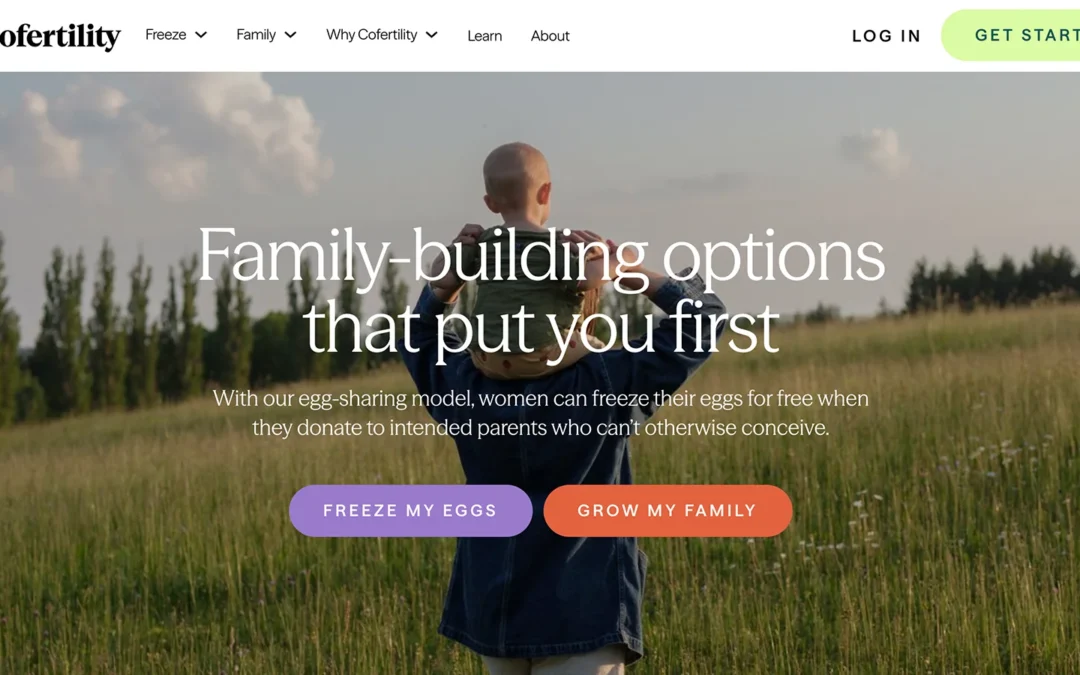
Cofertility: A $0 egg-freezing model built on a rebrand that refuses the category’s defaults

Cofertility: A $0 egg-freezing model built on a rebrand that refuses the category’s defaults

Members freeze their eggs for free when they donate half to a family that can't otherwise conceive, and the late-2025 rebrand behind that model shows why positioning can matter as much as the offer itself.

Fertility branding has a well-worn playbook: urgency, fear, and a palette of clinical blue. Cofertility, a fertility company backed by tennis star Maria Sharapova, built its entire identity by refusing that playbook, and the result is a case study in how naming architecture and visual system can do commercial work that a feature list can't.

A burst icon and an untangled name

In late 2025, Cofertility relaunched its identity around a new "burst" mark, an icon that reads simultaneously as a sunburst, a cell, a snowflake, or a north star depending on the viewer, paired with a rebuilt wordmark using connected letterforms for legibility.

The company also fixed a naming problem that had been quietly confusing customers: "Freeze by Co" became Cofertility Freeze, and "Family by Co" became Cofertility Family, putting the masterbrand first across both of its programs, egg freezing and donor family building.

The palette deliberately separates the two programs while avoiding the clinical blue that dominates fertility branding, and a confetti motif plus non-stock photography replaced the tired imagery of women and babies the category defaults to.

Strategic before visual

The sharpest move here isn't the mark itself, it's the decision to lead with celebration and inclusivity rather than urgency and fear, in a category where nearly every competitor still reaches for the same clinical, anxiety-driven register. Fixing the naming confusion between "Freeze by Co" and "Family by Co" also removed a real, measurable customer problem, a reminder that what a company calls its products can matter as much as its logo, and that brand architecture is a functional decision, not just an aesthetic one.

A system built to absorb what comes next

The flexible system Cofertility has built, separating programs by palette while unifying them under one masterbrand, is designed to absorb future services without another identity overhaul. Watch whether the company adds a third program under the same "Cofertility [Name]" convention, since that would be the clearest sign the naming fix was built for scale, not just for the two programs it currently has.