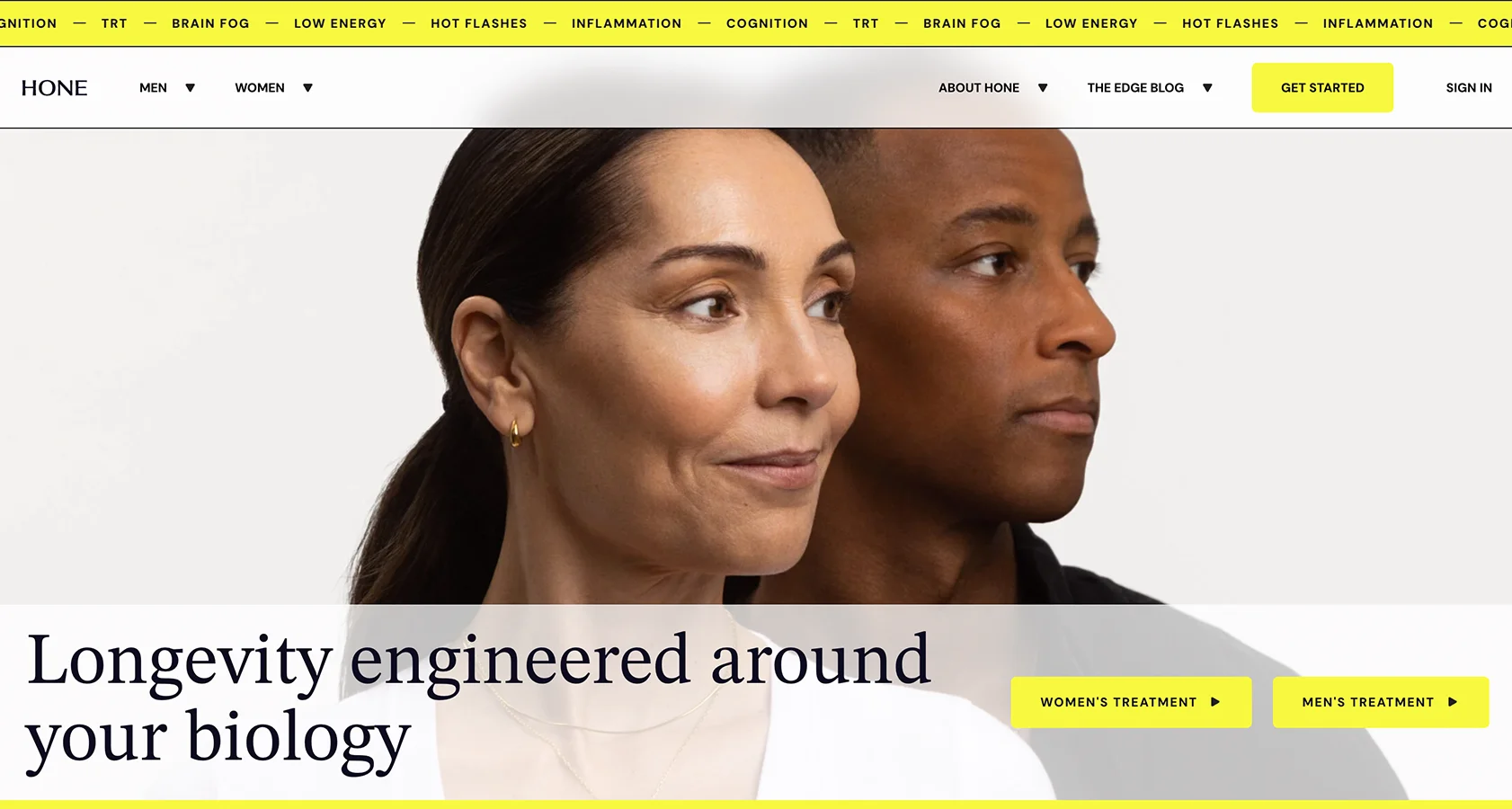
Pairing at-home hormone testing with physician-guided treatment gives Hone Health a wedge into men's health, a category defined less by lack of options and more by lack of engagement.
Hone Health is a men's health and longevity platform that pairs at-home hormone testing with physician-guided treatment. Men's health as a category has never really suffered from a lack of available treatments, testosterone therapy and related interventions have existed for decades, it's suffered from men simply not showing up to get evaluated in the first place. Hone's model is built around solving that engagement problem before trying to solve anything clinical.
Testing first, engagement second
Starting with an at-home hormone test rather than a consultation lowers the barrier to entry for a population that statistically avoids scheduling preventive care, turning "get tested" into a much smaller ask than "book a doctor's appointment." The at-home kit removes the two biggest friction points at once: the discomfort of an in-person conversation about symptoms many men are reluctant to raise, and the logistical hurdle of scheduling a visit they weren't already inclined to make. By the time a physician conversation happens, the patient already has data in hand, which shortens and de-stigmatizes the actual clinical encounter.
Men are well documented to engage with preventive healthcare at lower rates than women across nearly every age bracket, making the at-home-first entry point a deliberate design choice rather than a convenience feature.
Removing the appointment as the first step
The single biggest lever in men's health engagement isn't better treatment, it's getting men to start at all. By making the test itself the entry point rather than a scheduled visit, Hone Health is solving an engagement problem before it becomes a clinical one. That sequencing, test first, then talk, also changes the tone of the eventual physician conversation, since it starts from concrete data rather than a man having to volunteer symptoms he might otherwise minimize or avoid mentioning.
Whether testing converts into ongoing care
Watch the conversion rate from initial at-home test to ongoing physician-guided treatment, since that's the real measure of whether the low-friction entry point is actually building lasting engagement or just generating one-off test purchases. A test kit that gets purchased once and never followed up on isn't solving the underlying engagement problem, it's just relocating it slightly. Hone's long-term defensibility depends on proving that the testing wedge reliably converts into a continuing physician relationship, not just a single transaction.